
CCA Committees do the work of the organization and make recommendations to CCA.

Board Committees
Board Committees meet on a regular basis to do the ongoing work of CCA, typically meeting and working at least once a month during the academic year. As a result, these committees are made up of Board members and are chaired by officers or board members with the experience and knowledge necessary to perform the duties and fulfill the responsibilities of the committee. CCA has four board committees that report to the Board and ultimately to the CCA Council and the local chapters.
Budget Committee
Committee Responsibilities
- Shall oversee all budgetary activities of CCA;
- Shall review and update the Board and Councils on changes to CTA and NEA Budget policies;
- Shall assist in the development of the annual budgets;
- Shall review monthly financial statements and general ledgers at least four times a year, including at each stand-alone Board meeting;
- Shall consider requests for Crisis Assistance as they arise, in accordance with Standing Rule 2-6;
- Shall explain any budget variances, whether in revenue or expenditure portions of the budget to the Board and Council.
The CCA Budget Committee maintains fiscal oversight for CCA. Members routinely examine the ledgers to ensure correctness of bookkeeping, analyze anomalies and make recommendations to the CCA Board based upon these analyses. The Budget Committee also provides support to other CCA Committees through collaborative dialogue, information sharing, and problem solving over areas of mutual interest. CCA is funded almost entirely through member dues, and budget development occurs year-round. The Treasurer, in collaboration with CCA’s Budget Committee and with CTA, develops and proposes to Council in Spring an annual budget for the following year; that budget is adjusted mid-year and brought to Council for approval in Fall or Winter. To the greatest degree possible, member dues are returned to our locals and our members through conferences, grants, equity and social justice programs, crisis assistance, and other programs.
Members: Jesus Gutierrez, chair; Jackie Boboye, vice-chair; Geoff Johnson, Rudy Rios, and Anthony Villarreal.


Communications Committee
Committee Responsibilities
- Shall research, design, and then review the production and distribution of new forms of communication which shall help CCA serve its members;
- Shall liaison with CTA and NEA publications and other faculty associations to provide accurate and consistent information for publication about CCA issues, concerns, and/or activities;
- Shall review and help implement changes to the design and content of the CCA website;
- Shall ensure that all publications and the website are kept up to date and competitive with other faculty organizations and that any changes are made in a timely manner.
The Communications Committee works in conjunction with the CCA Website Manager/ Social Media Curator and CTA Communications Staff to disseminate valuable information to members regarding union news, local achievements, and current events that affect community college faculty. The committee oversees the CCA website, CCA social media accounts on Facebook, Instagram, and Twitter (X), and print publications—The Advocate and The Union Voice—contributing on a regular basis. The Communications Committee is also awards the annual CCA Advocacy Award each Spring. CCA Advocacy Award Application
Members: Caleb Castaneda, chair; Toni Pirtle, vice-chair; Sam Abbas, Jennifer Escobar, John Martin, Jacqueline Penhos; ex-officio, non-voting, John Sullivan, CCA Secretary
Assigned Staff: Jessica Beard (CTA Communications Staff), Casey Brown (Website consultant), Casey Jones (Social Media consultant)

Conference Committee
Committee Responsibilities
- Shall plan, organize, and implement CCA Conferences as set by the Board;
- Shall research locations and propose dates for future CCA Conferences at least two years in advance;
- Shall determine Conference schedules following the templates designed by the Committee. Templates shall be set for each conference;
- At least one session or component per conference shall address part-time faculty issues;
- At least one session or component per conference shall address issues of equity and/or diversity;
- Women’s issues shall be represented in at least one conference per year;
- LGBTQ+ issues shall be represented in at least one conference or standalone workshop per year;
- BIPOC issues shall be represented in at least one conference or stand-alone workshop per year;
- Undocumented student issues shall be represented in at least one conference or stand-alone workshop per year.
- A general Saturday morning session for elections shall be scheduled for each fall and spring council at which there is to be an election.
- Shall provide Conference evaluations and review for future conference activities;
- Shall report back to CCA Officers and Board on the success and recommended changes to conferences;
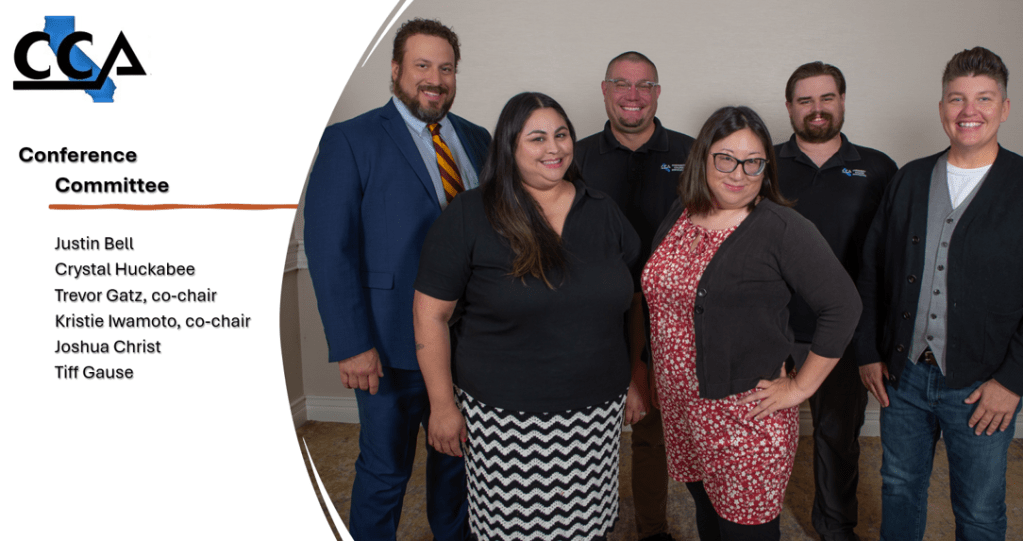
The Conference Committee is tasked with the selection, organization, and implementation of CCA’s three conferences in Fall, Winter, and Spring. The committee members work with CTA staff and the CTA Conference Center to create and plan each of the conferences from determining workshop topics and choosing the hotel venue to ordering meals and setting up events like the annual W.H.O Awards. The Conference Committee is always looking for new ideas for workshops and speakers: Do you have an idea or proposal for a session at one of our conferences? Fill out the form below to have it considered.
CCA Conference Session Proposal Form
Members: Trevor Gatz & Kristie Iwamoto, co-chairs; Justin Bell, Joshua Christ, Tiff Gause, Crystal Huckabee
Assigned Staff: Cathy McGuigan and Christopher Portillo
Governance Committee
Committee Responsibilities
- Shall review and revise as needed all governing documents of CCA at least once every five years;
- Shall consider all proposed amendments and changes to CCA’s governing documents;
- Shall review the governance structure and geographical districts of CCA every three years for adherence to CCA, CTA, and NEA policies;
- Shall bring forth all revisions and suggested changes to the Board and Councils, and advise these bodies of any compliance issues. Changes and/or additions to governance documents shall be reported in the Board and/or Council minutes with the modification added as an appendix;
- May conduct hearings on any proposed changes to governing documents;
- Shall provide oversight of all CCA conducted elections;
- Shall assist in certifying delegates at CCA Councils;
- Shall work to maintain the integrity of all matters of the Association pertaining to Governance.
The Governance Committee maintains the CCA governance documents: the Bylaws, the Standing Rules, and the Elections Manual. This is accomplished by reviewing and revising, as needed, all governing documents of CCA at least once every five years, considering all proposed amendments and changes to CCA’s governing documents, and reviewing the governance structure and geographical districts of CCA every three years for adherence to CCA, CTA, and NEA policies. The Governance Committee also brings forth all revisions and suggested changes to the Board and Councils and advises these bodies of any compliance issues. The Committee may conduct hearings on any proposed changes to governing documents.
Members: Patrick Mitchell, chair; Lorraine Slattery, vice-chair; Ricardo Aguilar, Scott Douglas, Pamela James


Council Committees
Council Committees report to the CCA Council that meets three times per year. Committees are made up primarily of members of the local chapters. For more information on the role and responsibilities of each committee, please consult the CCA Bylaws.


Advocacy Committee
Committee Responsibilities forthcoming
The Advocacy Committee discovers and analyzes advocacy issues relevant to community college budgets, legislation, and other areas, and coordinates with CCA committees as appropriate to organize around timely issues.
Members: Chair, Denise Muro (Riverside CCD), Andrew Aleman (Desert CCD), EJ Baldonado-Wilkins (South Orange CCD), Janet Hill (Riverside CCD), Kevin Leeds (Rancho Santiago CCD), Maria Ortiz (San Bernardino CCD)
Campus Safety Committee
Committee Responsibilities
- Shall examine, research, and report out concerns about campus safety issues, including but not limited to: lockdowns, public health, OSHA concerns, preparation for natural disaster, etc.;
- Shall coordinate with appropriate committees, task forces, and staff to ensure that safety concerns are addressed in all public relations and communication materials that represent CCA membership;
- Shall study issues and recommend policies to the CCA Policy Committee and legislation to the CCA Legislation & Advocacy Committee;
- Shall work with the CCA Conference Committee to facilitate conference training and events that seek to inform faculty of ways to improve campus safety conditions;
- Should include members with experience dealing with safety issues in their local districts.
Studies campus safety issues—including but not limited to lockdowns, public health, OSHA concerns, preparation for natural disaster—and coordinates with appropriate CCA bodies to recommend policy, legislation, public relations, communications, and conference sessions. This is CCA’s newest committee.
Members: Chair, Jennifer Fowlie (Victor Valley CCD), Morrie Barembaum (FARSCCD), Briana Boykin (Riverside CCD), Greg Gibson (San Joaquin Delta CCD), Jessy Lemieux (San Bernardino CCD), Frank Sotelo (Rio Hondo CCD), Ashley Vizenor (Barstow CCD)
Nonvoting member: Joanna Haan (Long Beach FA)


Elections & Credentials
Committee Responsibilities
- a. Shall conduct elections in accordance with the guidelines in the CCA Elections Manual; any issue not addressed in the CCA Elections Manual shall be determined by the CTA Elections Manual.
- Conducting elections shall include seeking nominations for Officers and Board Directors; preparing ballots; determining the set-up, security, and efficient operation of the polling place; counting ballots; and reporting results.
- The Elections and Credentials Committee chair shall consult with the CCA Governance Committee liaison on questions regarding the interpretation of CCA governance documents.
- Shall review and suggest revisions of the “CCA Elections Manual” to the CCA Governance Committee and in accordance with CCA, CTA, and NEA policies;
- Shall assist in certifying delegates to CCA Councils;
- Shall conduct recall elections in accordance with the requirements in the CCA Bylaws;
- Shall be comprised of active members of CCA/CTA/NEA who are:
- not running for an office in the current CCA election;
- not a sitting officer or board member in CCA, CTA, or NEA.
The Elections Credential Committee’s function is to conduct and monitor all CCA elections. The committee is charged with 1) ensuring every member has a voice, a vote, and access to the election process and procedures; 2) guaranteeing the right to have a voice in the organization, and 3) maintaining the one person, one vote and open nomination process set down by the CTA and NEA. The members of the Elections Credential Committee are at all times impartial and operate in the best interest of the CCA, CTA and NEA. To ensure the integrity of the process, the committee regularly reviews the election processes and proceedings and makes suggested modifications to the CCA Governance Committee. Visit the CCA Elections Page for more information and to find the CCA Elections Manual.
Members: Chair, Forest Quinlin (Napa Valley CCD), Josue Arredondo (Southwestern CCD), Kenneth Lambright (Mt SAC CCD), Josie Malik (San Joaquin Delta CCD), Elizabeth Maloney (San Joaquin Delta CCD), Meridyth McLaren (San Bernardino CCD), Tony Musumba (Riverside CCD)
Contact Elections
Faculty Equity and Diversity Committee (FEDC)
Committee Responsibilities
- Shall examine CCA policies and functions to ensure that equity is maintained as stated in CCA policy and governing documents as well as in accordance with legal parameters;
- Shall study issues and recommend policies to the CCA Board and/or Council on affirmative action and equality concerns relating to higher education;
- Shall coordinate with other committees, task forces, and staff to ensure that minorities and women are represented in all public relations and communication materials that represent CCA;
- Should include at least two local chapters’ faculty equity chairs or equivalent;
- At-large directors are authorized to attend FEDC meetings as guests;
- Shall include as ex-officio members one (1) Women’s Rights and Empowerment Director, one (1) LGBTQ+ Director, one (1) BIPOC Equity & Justice Director, and one (1) Part-Time Faculty Director.
The Faculty Equity and Diversity Committee addresses issues regarding ethnic, gender, age, economic and cultural equity within CCA. The FEDC creates conference sessions and stand-alone workshops. From member nominations, we select the annual winners of the Faculty Equity and Diversity Awards for outstanding service on behalf of community college faculty: The GBLT Award in honor of David Sanchez, The Ethnic Minority Award in honor of Mary Ann Pacheco, and The Part-time Faculty Award in honor of David Milroy. Our main goal is to educate our members in issues of diversity by celebrating our differences while embracing our commonalities and unity. We believe a strong union represents every member. For more information please visit our Equity and Diversity page.
Members: Chair, Ed Gomez (San Bernardino CCD), Maha Afra (NOCCD), Elias Escamilla (Mt. San Jacinto CCD), Steven Estrada (NOCCCD), Kenneth Lawler (San Bernardino CCD), Susan Pynes (MiraCosta CCD), Noushin Seddighzadeh (SOCCCD), Tiff Gause (LGBTQ+ ex-officio.), Pamela James (BIPOC ex-officio), Geoff Johnson (Part -Time ex-officio), Jacqueline Penhos (Women’s ex-officio)
Nonvoting members: Sam Abbas (South Orange CCD), Kristie Iwamoto (Napa Valley CCD)

Legislation Committee (LC)
Committee Responsibilities
- Shall recommend CCA positions and policies regarding federal and state legislation to CCA Council and CTA State Council;
- Shall promote political action programs with the CCA and CTA;
- Shall present needed legislation for Council approval and recommend legislation for presentation to the CTA State Council;
- CCA Interim Legislation Advisory Committee:
- In the event that CCA must take an immediate legislative position and cannot follow the procedure outlined above, the CCA President shall call a meeting of the Interim Legislation Advisory Committee.
- The CCA Vice President or designee shall report actions of the Interim Legislation Advisory Committee to the Legislation and Advocacy Committee, the CCA Board, and at the CCA Council at their next meetings;
- The CCA Interim Legislation Advisory Committee shall consist of:
- the CCA Officers;
- Chairperson and vice-chair of the Legislation and Advocacy Committee;
- available members of the Legislation and Advocacy Committee;
- the CTA District Q Director representing Higher Education;
- the CTA Legislative Advocate who is currently working on CCA legislative issues shall serve as a consultant to the committee;
- other CCA members appointed by the President based upon their expertise.
- The committee should be composed of currently serving CCA delegates to CTA State Council.
The Legislation and Advocacy Committee reviews all legislation pertaining to higher education, recommends positions to the CCA Council and the CTA State Legislation Committee, proposes sponsored legislation, and promotes political action in CCA.
For of current legislation and detailed legislative information, please visit the CCA Legislation & Political Action webpage.
Members: Acting Chair, Joshua Christ, Sandy Esslinger (Mt. San Antonio CCD), Harry Mersmann (San Joaquin Delta CCD), David Rentz (Chaffey CCD), Tami Smith (Mt. San Jacinto CCD), Louis Williams (Rio Hondo CCD), Justin Bell (Part-Time ex-officio – voting), Geoffrey Johnson (Part-Time ex-officio – voting), Emily Woolery (ex-officio – voting)
Nonvoting members: Suzanne Engelhardt (Long Beach CCD)
CTA Staff Support: Toni Trigueiro, Legislative Advocate; Diego Santelices, Legislative Consultant
Membership Development (MDC)
Committee Responsibilities
- Shall create and implement strategies to increase membership in CCA/CTA chapters;
- Shall work with the CCA Vice President to develop, coordinate, and support membership activities;
- Shall review and approve membership development grants, subject to availability of funds;
- Shall work with CCA Communications Committee to develop membership publications and to provide up-to-date membership information on the CCA Website;
- Shall staff and maintain a membership information table at all CCA conferences;
- Shall research and suggest membership activities to local chapters and offer local and/or regional membership training;
- Should be made up of local chapters’ membership chairs;
- The PTFIC chair or designee shall be an ex-officio voting member.
The Membership Development Committee meets regularly to address membership recruitment, development, and retention; to solicit, fund, and review Membership Development Grant proposals; and to advise CCA on all relevant membership matters.
Members: Chair, Heidi Ahders (Mendocino CCD), Vice Chair, Gerhard Peters (Citrus CCD), Wonderful Nancy Allah (SOCCCD), Jacques Belval (Monterey Peninsula CCD), Raquel Flores-Olson (Rio Hondo CCD), Janice Timm (Mendocino-Lake CCD), Julia Wendt (Victor Valley CCD), Geoff Johnson (Part-Time ex-officio voting)
Nonvoting members: Josie Malik (San Joaquin Delta CCD), Jackie Boboye (Chaffey CCD)


Organizing Committee
Committee Responsibilities
- Shall create and implement strategies to assist chapters in developing organizing ideas and implementing them in conjunction with CCA/CTA resources;
- Shall work with CCA/CTA staff to develop, coordinate, and support organizing activities;
- Shall work with CCA Communications Committee to develop organizing publications and to provide up-to-date organizing information on the CCA Website;
- Shall staff and maintain an organizing table at all CCA conferences;
- Shall research and suggest organizing activities to local chapters and offer local and/or regional organizing training;
- Should be made up of local chapters’ organizing chairs or equivalent;
- The PTFIC chair or designee shall be an ex-officio voting member.
The Organizing Committee supports chapters in creating and executing organizing strategies, utilizing resources from CCA/CTA. It collaborates with CCA/CTA staff to plan, coordinate, and promote organizing efforts. Additionally, the Committee partners with the CCA Communications Committee to produce organizing materials and maintain current information on the CCA website. It also researches and suggests organizing initiatives for local chapters and provides training to help them strengthen their organizing skills.
Members: Chair, Judy Lawton (Mt. San Antonio CCD), Maya Alvarez-Galvan (Mt. San Antonio CCD), Kim Dieu (Palo Verde CCD), Adam Fong (Merced CCD), Ruth Gutierrez (NOCCCD), Janet Hill (Riverside CCD), Diana Valladares (Rio Hondo CCD), Justin Bell (ex-officio – voting) or Geoffrey Johnson
Nonvoting members: Ricardo Aguilar (San Joaquin Delta CCD), Wonderful Nancy Allah (SOCCCD)
Part-time Faculty Issues Committee (PTFIC)
Committee Responsibilities
- Shall examine, research, and report out concerns about part-time faculty rights and representation;
- Shall coordinate with appropriate committees, task forces, and staff to ensure that part-time faculty are represented in all public relations and communication materials that represent CCA membership;
- Shall study issues and recommend policies to the CCA Policy Committee and legislation to the CCA Legislation & Advocacy Committee;
- Shall work with the CCA Conference Committee to facilitate conference training and events that seek to inform faculty of ways to improve part-time faculty working conditions; and shall provide a liaison to the CCA Conference Committee to ensure that conferences address both part-time and full-time faculty issues;
- Should be made up of local chapters’ part-time faculty representatives; it shall also have one full-time faculty member; however, the committee shall always be composed of a majority of part-time faculty.
The Part-Time Faculty Issues Committee supports part-time/adjunct/associate faculty rights in local and statewide bodies, communicates issues to the CCA Council, presents workshops at CCA conferences, and works with other CCA committees and the CCA Board to make sure that part-time faculty are fairly represented. For more information, please visit our Part Time Faculty Issues Page
Members: Chair, Justin Bell (ex-officio – voting), Candace Brabant (Riverside CCD), Martha Carreon (Rio Hondo CCD), Joshua Gleason (Chaffey CCD), Karol McCool (Riverside CCD), Nancy Roback (FT) (Long Beach CCD), Abigail Morales (CHI), Jacques Belval (Monterey Peninsula CCD), Geoffrey Johnson (ex-officio – voting)

Policy Committee
Committee Responsibilities
- Shall write or revise policy that will determine the positions that CCA and CTA will take on legislation that affect CCA members and higher education;
- Shall study current legislation; political issues; debates about education in the state and nation; and discussions and policies coming from the California Community College Chancellor’s Office (CCC CO), California Department of Education (CDE), and US Department of Education (US DOE); from these studies, the committee should recommend CCA policies concerning professional matters that affect educational programs and services, potential or proposed Community College legislation, and bargaining issues;
- Shall identify areas of CCA and/or CTA policy in the CTA Organizational Handbook that need amending;
- Shall advise the CCA officers, Board of Directors, and CCA committees on issues relating to CCA positions on legislation and proposed policies by the CCCCO, CDE, US DOE, college districts, or other organizations;
- Shall provide research regarding new policies being studied or implemented by administrations or outside organizations;
- Shall coordinate with the CCA Legislation and Advocacy Committee;
- Shall submit policy changes to the CCA Council that will be part of the Higher Education section of the CTA Organizational Handbook. Such policy changes, after being approved by CCA Council, become the official policy of CCA without further oversight;
- In the event that policy changes are needed before the next CCA Council meeting, the CCA Board may approve policy changes on an interim basis. These changes shall be presented to the CCA Council at its next meeting for final approval.
- Should be composed of currently serving CCA delegates to CTA State Council.
The Policy Committee writes and revises policy to support CCA positions on legislation and reviews current educational or labor issues which may require creation of new policy. CTA cannot take legislative positions, CTA advocates cannot lobby unless there is policy that supports the position CCA and CTA take. All CCA policy can be found in the CTA Organizational Handbook.
Members: Chair, Jon Ausubel (Chaffey CCD), Dana DeMercurio (San Joaquin Delta CCD), Andy Doyle (Rio Hondo CCD), Megan Igo (Merced CCD), Matt Kronzer (Napa Valley CCD), Kathleen McAlister (NOCCCD), Emily Woolery (Mt. San Antonio CCD), Michelle Nava (Mt. San Antonio CCD), Justin Bell (ex-officio – voting), Geoffery Johnson (ex-officio –voting)
CTA Staff: Demetrio Gonzalez, Policy Consultant
